


15-Day
Refurbishment cadence
OEM-Spec
Verified against OEM and published benchmarks; report included.
On-Staff
Solution Scientists
Since 1996
Three decades supporting labs
What you are buying
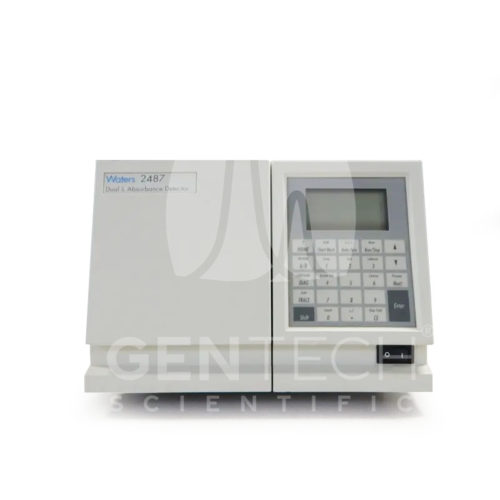
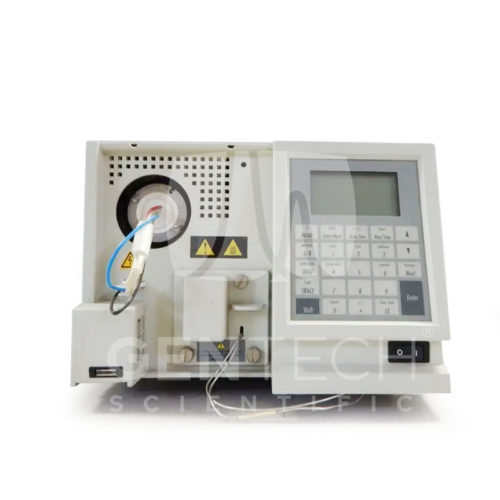
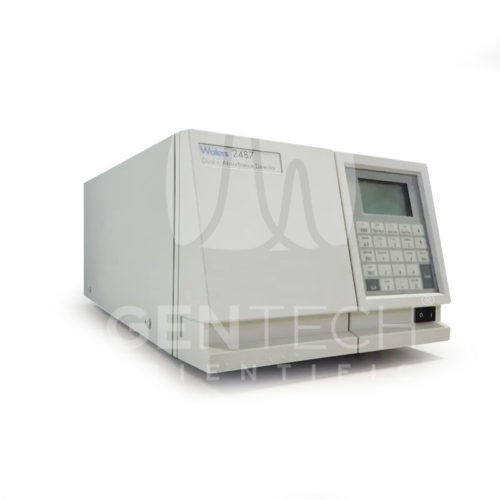
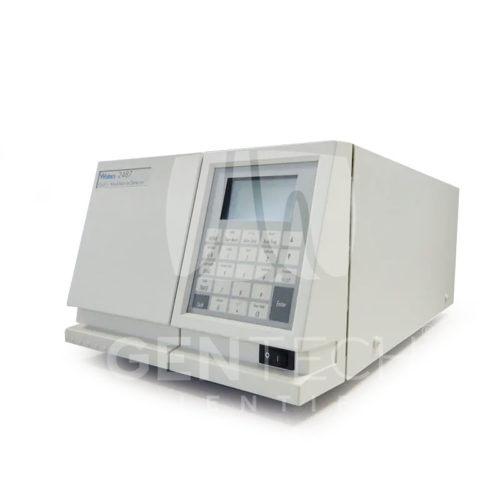
A refurbished Waters 2487 Dual Absorbance Detector. It monitors absorbance at one or two discrete wavelengths, running either standalone with a chart recorder or integrator, or as part of a Waters HPLC system.
Every unit moves through the GenTech Certified process. Solution Scientists disassemble and inspect each module, replace all consumables and degraded wear components, then tune and calibrate the instrument and verify performance against OEM and published benchmarks using known reference chemicals. The instrument ships with its verification report. A certified-refurbished system gives you that performance without the capital cost or the lead time of a new purchase.
What Agilent says about this platform
The 2487 Dual Absorbance Detector covers 190 to 700 nanometers using a deuterium arc lamp rated for 2,000 hours, with a 5-nanometer bandwidth and wavelength accuracy within 1 nanometer. Drift holds to 1 x 10 to the negative fourth AU per hour. The standard analytical flow cell uses a patented TaperSlit design, with a 10-millimeter path length, a 10-microliter volume, and a 1,000 psi pressure limit. Stand-alone programmability stores up to 10 user-defined methods, each with up to 16 timed events and 2 threshold events. An automatic second-order filter engages at wavelengths of 370 nanometers and above, removing itself at 369 nanometers and below. Spectrum scan and storage functions support scanning, display, subtraction, storage, and playback. A cuvette qualification feature lets an operator verify the detector using a standard inserted in a cuvette, without breaking any fluidic connections, and can also turn the 2487 into a benchtop spectrophotometer. The detector operates from 4 to 40 degrees Celsius and runs on 120 or 220 volts at 50 or 60 hertz.
What each module does
Binary solvent management
Monitors absorbance at one or two discrete wavelengths as each compound elutes, with MaxPlot and RatioPlot functions to maximize sensitivity and assess peak homogeneity.
| In this stack | |
| Waters 2487 Detector Waters 2487 Detector | Verified |
| 1260 Vialsampler G7129A | Verified |
| 1260 Multicolumn Thermostat G7116A | Verified |
| 1260 Diode Array Detector G7115A | Verified |
|
Workstation loaded with software
|
Included |
| Each module is individually serialized and performance-verified before the stack is assembled and tested as a complete system. | |
Technical detail
| Wavelength range | 190 to 700 nm |
| Bandwidth | 5 nm |
| Wavelength accuracy | ±1 nm |
| Drift | 1 x 10⁻⁴ AU/hr |
| Software | Included |
*OEM specifications for brand new instrument.
What “GenTech Certified” means
Refurbishment at GenTech is a defined process, not a wipe-down. Every system moves through the same five stages.
1. Disassembly and rebuild. Solution Scientists strip the instrument down, clean each module inside and out, and rebuild it from the frame up. They replace pump seals, pistons, and check valves to specification.
2. Configuration and new parts. Solution Scientists install the options and modules you selected and fit new wear parts throughout. They replace the detector lamp with a new one and reset the lamp hours.
3. Diagnostic and performance testing. Solution Scientists tune and calibrate the instrument, run system diagnostics, and confirm detector wavelength accuracy. They test full-system pressure and gradient performance against OEM and published benchmarks using known reference chemicals.
4. Data package you approve before shipment. The verification data goes to you for approval before the system leaves the bench. You see exactly how the instrument performs before it ships.
5. Delivery and installation. The instrument ships in protective packing with a one-year warranty option and professional installation available from a GenTech Solution Scientist.
Labs that run this system
The Waters 2487 Dual Wavelength UV Detector is method-compatible across the techniques most regulated and research labs run every day. These are the application areas buyers ask about most.
PFAS testing
EPA Method 537.1 and similar state programs require quantitation of per- and polyfluoroalkyl substances in drinking water at low parts-per-trillion levels, a sensitivity range triple quadrupole MS is built to reach.
Pesticides and mycotoxins
Multi-residue pesticide panels and mycotoxin screens in food and cannabis testing often cover more than 100 compounds in a single run, each requiring the selectivity a triple quadrupole provides against a complex matrix background.
Trace impurities and cleaning validation
Pharmaceutical cleaning validation protocols confirm that equipment surfaces carry no detectable residue of the previous product, often down to sub-part-per-billion swab or rinse limits.
Quantitative toxicology
Forensic and clinical toxicology panels quantify drugs and metabolites in blood, urine, or tissue against legally defensible limits, where a triple quadrupole’s selectivity rules out false positives from matrix interferences.
GLP-grade quantitation
Good Laboratory Practice studies require documented, audit-ready quantitation with full method validation, a standard regulated bioanalysis labs run routinely on triple quadrupole platforms.
| Condition | Refurbished |
|---|---|
| Model | 2487 |
| OEM | Waters |
| Financing | Financing Options Available |
Financing Options Available. Finance Builder.
Need a main board instead?
Replacing a failed pump or looking to upgrade your HPLC? Every module in this system is available individually, in stock and performance-verified.


