15-Day
Refurbishment cadence
OEM-Spec
Verified against OEM and published benchmarks; report included.
On-Staff
Solution Scientists
Since 1996
Three decades supporting labs
What you are buying
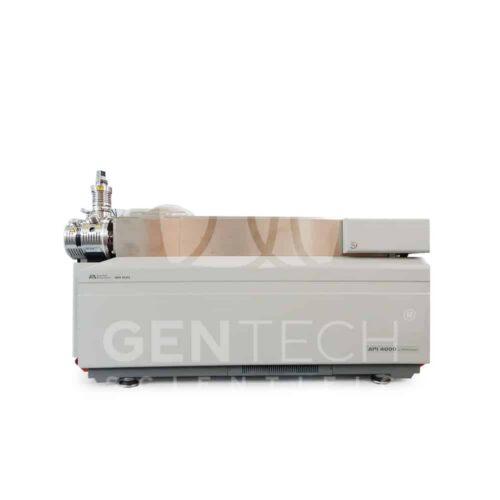
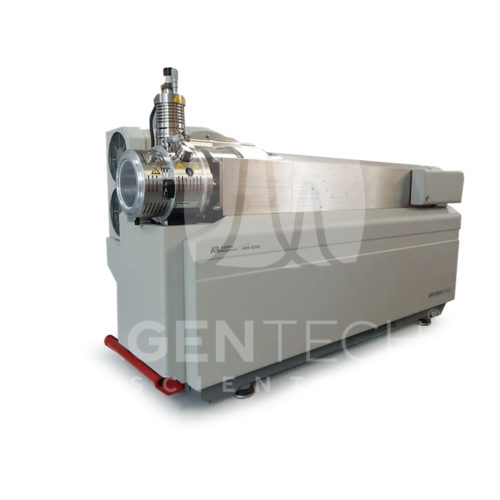
A refurbished AB Sciex API 4000 LC-MS/MS system. The liquid chromatograph front end separates the mixture and delivers it to the ion source. The source converts the eluent into gas-phase ions. The triple quadrupole isolates a precursor, fragments it, and measures the product ion for trace-level quantitation. GenTech rebuilds and tests the LC, the source, and the analyzer, then verifies the system end to end.
Every unit moves through the GenTech Certified process. Solution Scientists disassemble and inspect each module, replace all consumables and degraded wear components, then tune and calibrate the instrument and verify performance against OEM and published benchmarks using known reference chemicals. The instrument ships with its verification report. A certified-refurbished system gives you that performance without the capital cost or the lead time of a new purchase.
What Agilent says about this platform
SCIEX built the API 4000 around a Turbo V ion source with interchangeable TurboIonSpray and APCI probes, switching rapidly between the two for different ionization needs. The triple quadrupole architecture adds a second mass filter, Q3, after the collision cell; a Q1 prefilter and the Q1/Q3 mass filter quadrupoles sit in the high-vacuum region on either side of a LINAC collision cell, a ceramic housing pressurized with collision gas to fragment ions passing through. Mass range covers 5 to 2,800 m/z. Analyst software controls acquisition and data processing.
What each module does
Liquid chromatograph
Separates the mixture and delivers a reproducible gradient to the source. This listing does not specify a bundled HPLC brand; a compatible front end is sold separately or paired at the bench.
Ion source
A Turbo V source with interchangeable TurboIonSpray and APCI probes converts the liquid eluent into gas-phase ions, switching rapidly between the two.
Mass analyzer
Q1 and Q3 mass filter quadrupoles flank a LINAC collision cell. Q1 selects a precursor, the cell fragments it under pressurized collision gas, and Q3 measures the product ion for trace-level quantitation.
Vacuum and detection
Stages the ions from atmosphere to high vacuum, then counts them at the detector.
| In this stack | |
| AB Sciex API 4000 API 4000 | Verified |
| 1260 Vialsampler G7129A | Verified |
| 1260 Multicolumn Thermostat G7116A | Verified |
| 1260 Diode Array Detector G7115A | Verified |
|
Workstation loaded with software
|
Included |
| Each module is individually serialized and performance-verified before the stack is assembled and tested as a complete system. | |
Technical detail
| Analyzer | Triple quadrupole |
| Mass range | m/z 5 to 2,800 |
| Collision cell | LINAC, pressurized ceramic housing |
| Ion source | Turbo V, TurboIonSpray/APCI probes |
| Software | Analyst |
*OEM specifications for brand new instrument.
What “GenTech Certified” means
Refurbishment at GenTech is a defined process, not a wipe-down. Every system moves through the same five stages.
1. Disassembly and rebuild. Solution Scientists strip the instrument down, clean each module inside and out, and rebuild it from the frame up. They replace pump seals, pistons, and check valves to specification.
2. Configuration and new parts. Solution Scientists install the options and modules you selected and fit new wear parts throughout. They replace the detector lamp with a new one and reset the lamp hours.
3. Diagnostic and performance testing. Solution Scientists tune and calibrate the instrument, run system diagnostics, and confirm detector wavelength accuracy. They test full-system pressure and gradient performance against OEM and published benchmarks using known reference chemicals.
4. Data package you approve before shipment. The verification data goes to you for approval before the system leaves the bench. You see exactly how the instrument performs before it ships.
5. Delivery and installation. The instrument ships in protective packing with a one-year warranty option and professional installation available from a GenTech Solution Scientist.
Labs that run this system
The AB Sciex QTrap 5500 is method-compatible across the techniques most regulated and research labs run every day. These are the application areas buyers ask about most.
PFAS testing
EPA Method 537.1 and similar state programs require quantitation of per- and polyfluoroalkyl substances in drinking water at low parts-per-trillion levels, a sensitivity range triple quadrupole MS is built to reach.
Pesticides and mycotoxins
Multi-residue pesticide panels and mycotoxin screens in food and cannabis testing often cover more than 100 compounds in a single run, each requiring the selectivity a triple quadrupole provides against a complex matrix background.
Trace impurities and cleaning validation
Pharmaceutical cleaning validation protocols confirm that equipment surfaces carry no detectable residue of the previous product, often down to sub-part-per-billion swab or rinse limits.
Quantitative toxicology
Forensic and clinical toxicology panels quantify drugs and metabolites in blood, urine, or tissue against legally defensible limits, where a triple quadrupole’s selectivity rules out false positives from matrix interferences.
GLP-grade quantitation
Good Laboratory Practice studies require documented, audit-ready quantitation with full method validation, a standard regulated bioanalysis labs run routinely on triple quadrupole platforms.
| Model | API 4000 |
|---|---|
| OEM | AB Sciex |
| Financing | Financing Options Available |
Financing Options Available. Finance Builder.
Need a main board instead?
Replacing a failed pump or looking to upgrade your mass spec? Every module in this system is available individually, in stock and performance-verified.