
Oil is a critical component for both your vacuum pump and the processes it supports. It serves several essential functions, acting as a lubricant, coolant, sealant, and contaminant carrier. Selecting the proper vacuum pump oil—and maintaining it correctly—can significantly affect pump performance, vacuum quality, and equipment longevity.
Key Functions of Vacuum Pump Oil
Understanding what vacuum pump oil does can help you appreciate why oil selection and maintenance are so important.
Sealing
Vacuum pump oil acts as a liquid seal between the pump’s moving components and internal surfaces. This oil film fills microscopic gaps, preventing air from leaking backward through the pump and reducing vacuum efficiency. Without an effective seal, many applications cannot achieve the deep vacuum levels they require.
Deep vacuum is important because it lowers the boiling point of liquids, allowing moisture and volatile contaminants to vaporize at lower temperatures. Once converted to vapor, these contaminants can be removed by the pump, helping keep the system clean and dry.
Lubrication
Oil reduces friction between moving components such as rotors, vanes, bearings, and gears. Proper lubrication minimizes wear, extends component life, and helps protect metal surfaces from corrosion.
Cooling
The compression of gases and mechanical friction generate substantial heat inside a vacuum pump. Oil absorbs this heat and transfers it to the pump housing, where it can dissipate into the surrounding environment. Effective cooling helps maintain stable operating temperatures and protects internal components from thermal damage.
Contaminant Capture
Vacuum pump oil also helps capture moisture, particulates, and process contaminants before they can damage internal components. By suspending these contaminants, the oil helps prevent excessive wear and corrosion within the pump.
The Importance of Clean Oil
Because vacuum pump oil performs so many critical functions, maintaining clean oil is essential.
Over time, oil absorbs moisture, solvents, process vapors, and particulates. As contamination levels increase, the oil’s sealing ability and lubricating properties begin to deteriorate. This can lead to slower pump-down times, reduced vacuum performance, increased operating temperatures, and accelerated component wear.
Contaminated or moisture-saturated (“wet”) oil can also contribute to corrosion, varnish formation, and, in severe cases, pump seizure or catastrophic failure. Regular oil inspection and replacement are among the simplest and most effective ways to extend pump life and maintain peak performance.
When Should Vacuum Pump Oil Be Changed?
Fresh vacuum pump oil is typically clear or light amber in color. As it oxidizes and accumulates contaminants, it may become yellow, brown, or black.
Visible signs that an oil change is needed include:
-
- Milky or cloudy appearance
- Foaming or frothing
- Dark discoloration
- Suspended debris or sludge
- Burnt odor
Performance indicators can also signal the need for an oil change. If the pump struggles to achieve its rated vacuum level, takes longer than normal to evacuate a system, or runs hotter than usual, the oil may be contaminated or degraded.
When visual inspection alone is inconclusive, a vacuum gauge or sensor can help assess pump performance. As a general guideline, many technicians recommend changing the oil after particularly demanding jobs, moisture-heavy applications, or every 20–50 hours of operation, depending on operating conditions and manufacturer recommendations.
What Vacuum Pump Oil Do I Need?
There is no universal vacuum pump oil suitable for every application. The optimal oil depends on the pump design, operating environment, process contaminants, temperature range, and vacuum requirements.
Understanding a few common oil specifications can help guide your selection.
Medium Viscosity (ISO VG 68)
Viscosity measures a fluid’s resistance to flow. An ISO VG 68 oil is considered a medium-viscosity lubricant, providing a balance between flow characteristics and sealing performance.
This viscosity grade is commonly used in vacuum pumps because it offers:
-
- Rapid oil circulation during startup
- Effective lubrication of moving components
- Strong sealing properties for achieving deep vacuum levels
- Reliable performance across a broad range of operating conditions
Semi-synthetic vacuum pump oils combine highly refined mineral oil with synthetic base stocks or performance-enhancing additives.
Semi-Synthetic Oil
Compared to conventional mineral oils, semi-synthetic formulations typically provide:
-
- Improved thermal stability
- Better oxidation resistance
- Enhanced cold-temperature flow characteristics
- Longer service life
- Reduced varnish and deposit formation
These benefits can often be achieved at a lower cost than fully synthetic vacuum pump oils.
A Vacuum Pump Oil Designed for Laboratory Applications
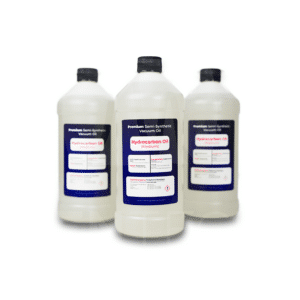
GenTech Scientific offers Chromatography Parts brand vacuum pump oil, a formulation developed specifically for analytical laboratory instrumentation, including mass spectrometers (MS), gas chromatographs (GC), and other vacuum-dependent systems.
Unlike general-purpose industrial oils, this specialized formulation is designed to meet the demanding requirements of laboratory environments where purity, stability, and performance consistency are critical. The oil features a medium viscosity grade (ISO VG 68) and a semi-synthetic formulation that helps provide reliable sealing, lubrication, and thermal stability for analytical instruments.
Chromatography Parts vacuum pump oil is available in both one-quart and one-gallon containers to accommodate laboratories of various sizes and maintenance schedules.
